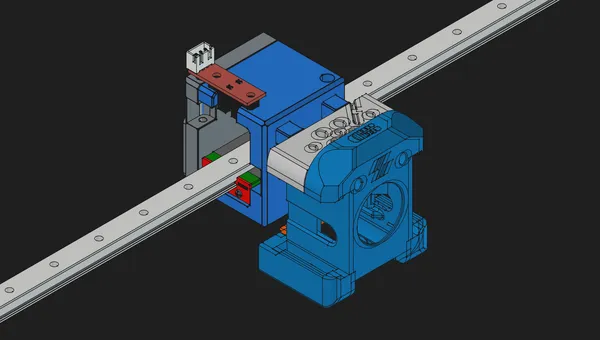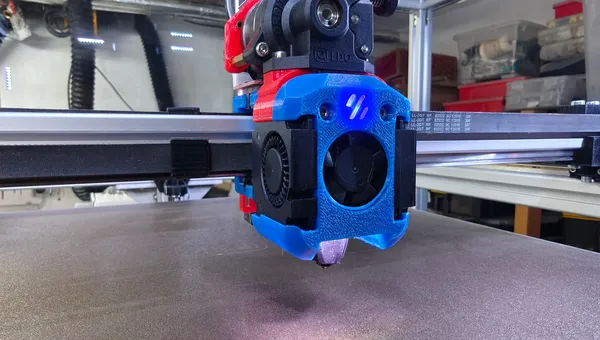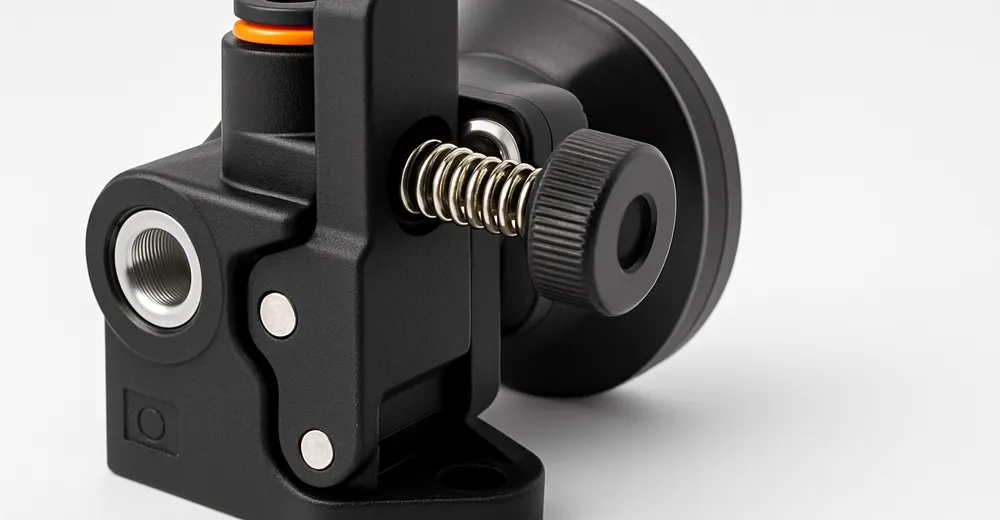
An honest field report: on my old printer, cheap dual-gear clones ran in a Bowden setup – and gave up over time. My new CoreXY needs direct drive anyway, so I deliberately put a genuine LDO Orbiter v2.5 on it instead of another clone. The Orbiter sits on the Dragon Burner toolhead together with the Rapido 2F – the complete Klipper config for it is in the Rapido 2F article.
Dual-gear direct drive – briefly explained
Two terms that often get mixed up. Dual-gear means: the filament is gripped by two driven, intermeshing gears, not just one wheel against a loose bearing. That doubles the grip area and reduces slip – especially with higher back-pressure or soft filament.
Direct drive, on the other hand, describes the location: the extruder sits right at the print head, the filament has only a few centimeters to the nozzle. With Bowden the motor sits on the frame and pushes through a long PTFE tube. Both can be combined – my old setup was Bowden with dual-gear, the new one is direct drive with dual-gear.
Ad · Affiliate link – if you buy through it, I may earn a commission. It doesn’t change the price for you.

My old setup: Bowden with dual-gear clones
On the old printer, cheap Bondtech clones ran in a Bowden setup. Flawless at first: clean feeding, even extrusion, nothing to complain about. But the pattern was the same with every clone – after a few months, depending on the filament meters printed, they became gradually unreliable.
First occasional slipping and under-extrusion on faster prints, then reproducible dropouts, and eventually a complete jam – the feed stalled and the gear just ground a notch into the filament. Not a sudden failure, but a clear wear curve.
Why the clones eventually jammed
No lab analysis, but the recurring pattern points to a few causes:
- Gear hardness: cheap clones often save exactly here. The hobbed teeth wear down, grip fades – on genuine brand parts the gears are usually hardened steel.
- Filament dust: with the meters, fine debris clogs the teeth. Clogged teeth grip worse, which promotes slipping and finally grinding.
- Idler tension & bearing play: springs weaken, cheap bearings develop play – the contact pressure becomes uneven.
- Bowden stress: the long path needs more aggressive retraction. That adds load to the feed and is less forgiving of fading grip.
Bottom line: the clones are wear parts with a short half-life. Cleaning and re-tensioning helped briefly each time, but didn't solve the root problem.
New printer, direct drive – and this time a genuine Orbiter
The new CoreXY is built for direct drive from the start – so the question wasn't whether direct drive, but which extruder. After the clone frustration on the old printer, I deliberately chose a genuine LDO Orbiter v2.5 instead of another cheap replica.
The Orbiter is compact and light enough for direct-drive operation right at the toolhead – on my build on the Dragon Burner above the Rapido 2F. Dual-gear with properly made, hardened gears and a light pancake stepper motor: exactly what the clone was missing. The short filament path of direct drive is a welcome bonus – retraction and pressure advance become less critical. The complete Klipper configuration (rotation_distance, PT1000, limits) is documented in the Rapido 2F article; here just the lines that matter for the Orbiter:
[extruder]
# LDO Orbiter v2.5 (dual-gear, direct drive)
rotation_distance: 4.637   # Orbiter v2.5 - fine-tune your own value with a measure test
microsteps: 16
full_steps_per_rotation: 200
pressure_advance: 0.06     # direct drive -> low, calibrate on the tuning tower

[tmc2209 extruder]
run_current: 0.85          # light pancake motor -> no high current needed
stealthchop_threshold: 0
Direct drive vs. Bowden – honest trade-offs
Direct drive isn't automatically better, it's a trade-off:
- Pro direct drive: short retraction, much better with flexibles (TPU), low pressure advance, shorter slip distance when grip fades.
- Con: more mass on the print head → more ringing/ghosting, input shaping becomes practically mandatory. The toolhead gets heavier, which sets limits at very high accelerations.
- Bowden still makes sense if the head needs to be as light as possible and you print almost only PLA/PETG with moderate retraction.
For my CoreXY with a high-flow hotend, direct drive was the more coherent choice – the light Orbiter keeps the added mass in check.
What I left out
- Exact filament meters until failure: not logged properly – the pattern was reproducible, the number would be a guess.
- Comparison with genuine Bondtech: I never had one, so no fair 1:1 test. This is about clones vs. Orbiter.
- Orbiter long-term test: it's only been running reliably for a short while – a real wear verdict comes later.
- Specific clone brand: deliberately no shaming of a single shop; the problem was clone quality in general.
Conclusion
Cheap dual-gear clones are a good price argument – but for me they're wear parts that lose grip and jam after a few months. A genuine, well-made dual-gear direct drive like the Orbiter v2.5 was the calmer solution: less slip, short path, predictable operation. If you constantly fight feeding problems, you're saving in the wrong place by skimping on the extruder.
Ad · Affiliate link – if you buy through it, I may earn a commission. It doesn’t change the price for you.